


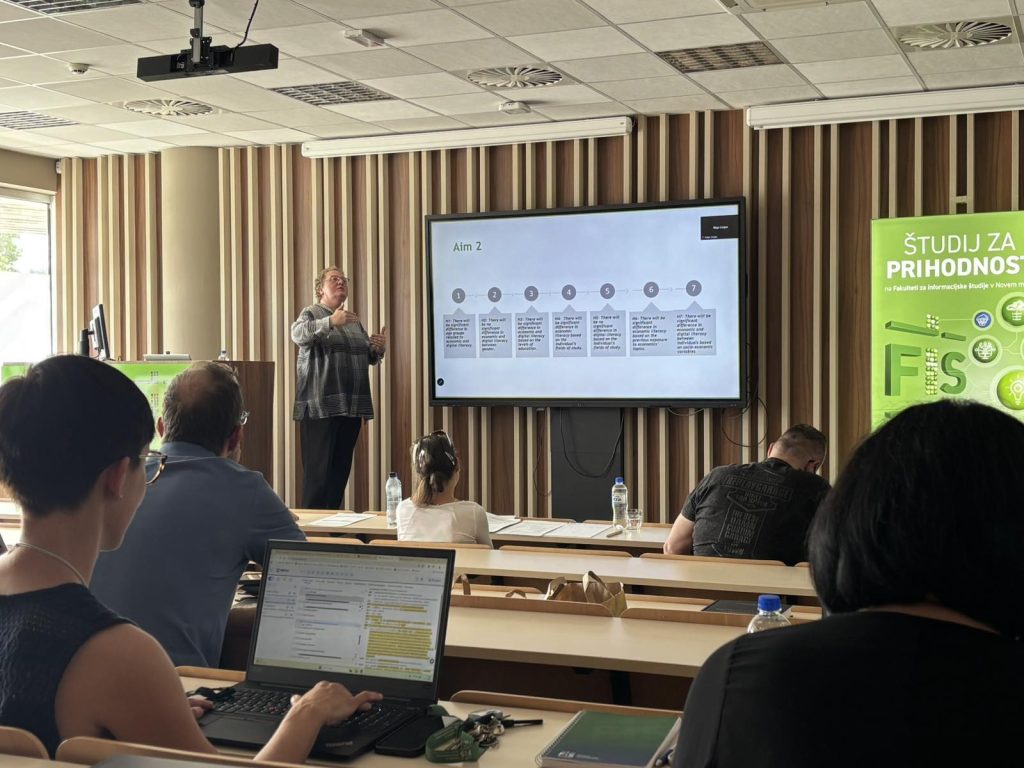

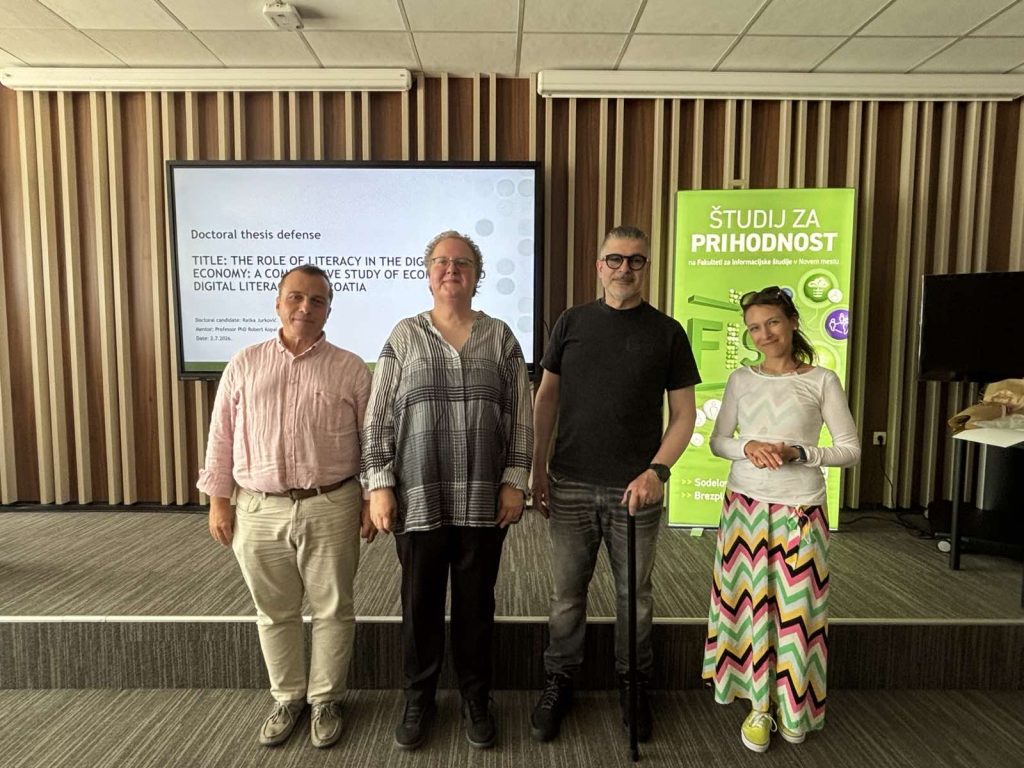
Today, July 2, 2026, doctoral candidate Ratka Jurković successfully defended her doctoral dissertation titled “The Role of Literacy in the Digital Economy: A Comparative Study of Economic and Digital Literacies in Croatia.”
The defense committee consisted of Assoc. Prof. Dr. Erika Džajić Uršič and Assoc. Prof. Dr. Janez Kolar.
She completed her doctoral dissertation under the supervision of Prof. Dr. Robert Kopala.
Digital economy in its broad scope entails manifestation of e-Business, e-Commerce, Industry 4.0 and algorithmic economy, requiring from the individual’s possession of variety of knowledge and skills to call oneself literate in the digital age. This thesis examines two of the literacies shown through the literature as being important for the augmentation of digital economy – digital literacy and economic literacy. Economic literacy and digital literacy are complementing one another in providing the set of skills which are important for modern digital economy and information society.
The aim of this research is to contribute to the literature on digital economies by addressing the research gap existing in examination of the literacies important for the enhancement and augmentation of skills needed for the digital economies to be enlarged – economic and digital literacy. This research wanted to give scientific contribution by researching countries outside the US and Western Europe, specifically Croatia and providing a theoretical model of predictors of economic and digital literacy.
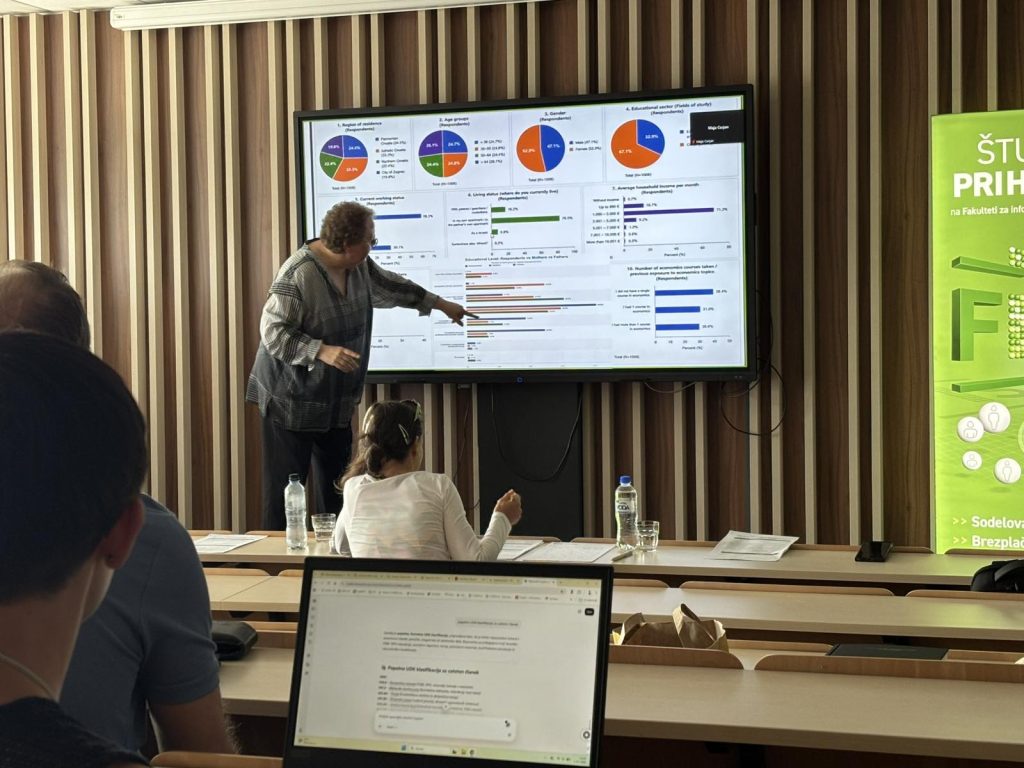
To do so, large-scale research on the representative sample in Croatia has been undertaken by means of Test of Economic Literacy, 4th version (TEL4) and Internets Skills Scale test which have been validated and/or translated and adopted for Croatian setting. Hypothesis were also formed, related to age, gender and various educational and socio-economic factors influencing economic and digital literacy. Results show that age, education, economic status, income and paternal (mother’s education) mattered with respect to digital and economic literacy. Results of hypotheses testing fortified with literature review findings served in forming of predictive models of economic and digital literacy. Age and education together with selected socio-economic factors were shown to be statistically significant predictors, however they explained rather modest portion of the variance in economic and digital literacy, emphasizing the multifaceted and complex nature of these literacies. Policy recommendations and possible future research venues were offered.
Sincere congratulations!